When Your WhatsApp Group Chat Turns Into a Banking Trojan Support Group

December 9, 2025

Synopsis
The analysis shows that Water Saci operators are running a highly automated, multi-stage banking-trojan campaign delivered through socially engineered WhatsApp attachments, using layered loaders, process hollowing, and IMAP/HTTPS C2 to hijack Brazilian banking and cryptocurrency sessions, which raises the likelihood of credential theft, fraud, and costly forensic and remediation actions. Strategically, organizations must account for non-email social-engineering vectors, adjust their fraud-risk assumptions, and update governance around consumer-messaging exposure; operationally, they must harden endpoints against script execution, improve monitoring for AutoIt- and HTA-driven behaviors, and ensure banking-session integrity; tactically, they need detection rules for HTA execution chains and svchost injection, plus rapid containment playbooks for compromised financial users. Risk posture worsens due to high threat capability, moderate-to-high susceptibility, and the attacker’s ability to bypass traditional controls. At the same time, financial resilience is pressured by potential transaction fraud, customer remediation, regulatory overhead, and incident-response costs that scale with the number of affected endpoints and accounts.
Evaluated Source, Context, and Claim
Artifact Title
Unraveling Water Saci's New Multi-Format, AI-Enhanced Attacks Propagated via WhatsApp
Source Type
Vendor threat research blog post (Trend Micro / Trend Vision One)
Publication Date: December 2, 2025
Credibility Assessment
Trend Micro is a long-established security vendor with mature telemetry, reverse-engineering, and threat-intelligence capabilities, which supports high technical credibility. As with all single-vendor reporting, some inferences (for example, AI involvement) should be treated as informed but not definitive.
General Claim
The Water Saci campaign in Brazil uses layered, multi-format malware delivered via socially engineered WhatsApp messages, with AI-assisted scripting, to propagate a banking trojan that targets Brazilian banking and cryptocurrency users while evading traditional endpoint defenses.
Narrative Reconstruction
A financially motivated cybercriminal group associated with the Water Saci campaign is conducting a multi-stage malware operation in Brazil that abuses WhatsApp to deliver malicious ZIP, PDF, and HTA attachments to users via socially engineered messages from trusted contacts. When victims open the HTA-based entry point, a layered chain of scripts, MSI installers, AutoIt loaders, and banking trojan payloads executes in a killchain-like flow, including system and browser reconnaissance, Brazilian bank and exchange targeting, security software enumeration, anti-virtualization checks, process hollowing into svchost.exe, registry-based persistence, and flexible HTTPS- plus IMAP-based command and control. The attackers appear to have transitioned their WhatsApp propagation tooling from PowerShell to an enhanced Python variant, plausibly with assistance from AI code-conversion tools, to automate contact harvesting and mass file sending via Selenium and browser drivers, increasing speed, reach, and resilience. The primary operational goal is to hijack Brazilian banking and cryptocurrency sessions on infected Windows endpoints, enabling remote control, credential capture, and potential fraud while evading straightforward pattern-based defenses and complicating incident analysis.
Risk Scenario
Risk Scenario
A financially motivated cybercriminal group compromises Brazilian users’ or employees’ Windows endpoints via socially engineered WhatsApp attachments, enabling a multi-stage banking trojan to hijack online banking and cryptocurrency sessions, causing fraudulent transactions and associated response costs.
Threat
A financially motivated cybercriminal group operating the Water Saci campaign, focused on Brazilian banking and cryptocurrency users, and able to adapt tooling (including porting propagation scripts from PowerShell to Python) to increase automation and reach.
Method
Socially engineered WhatsApp messages containing malicious multi-format attachments (ZIP, PDF, HTA) that trigger an HTA/VBScript entry point, download an MSI-based AutoIt loader, deploy a banking trojan that performs system and banking reconnaissance, executes anti-VM checks, uses process hollowing into svchost.exe, maintains registry-based persistence, and communicates with HTTPS- and IMAP-based C2 while automating further propagation via WhatsApp Web.
Asset
Windows endpoints used by Brazilian individuals or employees for online banking and cryptocurrency transactions, including associated browser sessions, banking security modules, local configurations, and stored or in-session financial credentials and transaction data.
Impact
Fraudulent or unauthorized banking and cryptocurrency transactions, compromise of banking sessions and credentials, potential misuse of access to institutional systems tied to those endpoints, incident-response and remediation labor, and possible downstream customer losses, disputes, and reputational damage for affected financial institutions or organizations whose users are compromised.
Evidentiary Basis for Synopsis and Recommendations
Supporting observations from the analysis help clarify how the threat landscape, control environment, and organizational behaviors interact to shape overall risk exposure. These insights provide the foundation for identifying where controls perform well, where gaps or weaknesses create unnecessary vulnerability, and how attacker methods intersect with real-world operational conditions. Building on these findings, the recommendations that follow focus on strengthening resilience, improving decision-making, and guiding readers toward practical steps that enhance both security posture and risk-informed governance.
FAIR Breakdown
Threat Event Frequency (TEF)
Because the OSINT describes a specific ongoing campaign rather than hard volume metrics, TEF must be inferred from the self-propagating WhatsApp automation, Brazil-wide target pool, and continuous banking focus. For a typical Brazilian financial institution or mid-sized organization with users active on WhatsApp Web, TEF is reasonably estimated as moderate, on the order of 6 Water Saci-related compromise attempts per year against its user or endpoint population.
Contact Frequency (CF)
WhatsApp-based delivery and automated contact blasting via the Python whatsz.py script indicate that once an endpoint in a given social or organizational graph is infected, many contacts may receive malicious attachments relatively quickly. For a single organization, this suggests a moderate CF: several phishing-style contact waves per year, clustered around newly infected internal or customer endpoints, with concentration in sectors and user communities that perform Brazilian online banking or use crypto platforms heavily.
Probably of Action (PoA)
The actors’ clear financial motivation, region-specific targeting, and iterative upgrades (multi-format delivery, AI-assisted code conversion, broader browser support, and robust backdoor features) indicate a high intent to execute whenever potential victims are reachable. Given enticing lures from trusted WhatsApp contacts and the streamlined HTA/MSI/AutoIt chain, PoA following each contact is likely high, as the campaign design is optimized for user execution rather than opportunistic drive-by exploitation.
Threat Capability (TCap)
TCap is high, reflecting multi-stage tooling, region-tuned banking reconnaissance, robust C2, and an upgraded Python propagation framework.
Exploit sophistication: The campaign uses layered file formats, obfuscated HTA/VB scripts, AutoIt-based loaders, RC4-like encryption, LZNT1 decompression, and process hollowing of svchost.exe, showing solid technical tradecraft beyond simple commodity malware.
Bypass ability: The malware performs anti-virtualization checks against VM-related services, enumerates antivirus processes and products, hides its payload via in-memory decryption and process hollowing, and blends C2 into normal HTTPS and IMAP traffic, indicating deliberate efforts to evade sandboxing and endpoint defenses.
Tooling maturity: The chain includes multiple redundant payload formats (.tda, .dmp), persistent process monitoring and re-injection, registry and Run-key persistence, IMAP-based dynamic C2 discovery, and a rich remote-control backdoor command set, all of which suggest a mature, well-maintained codebase.
Campaign success rate: Success depends on users opening malicious attachments from trusted WhatsApp contacts, a proven social-engineering vector in Brazil; combined with automation, this likely yields a moderate-to-high success rate within exposed populations, even if only a fraction of recipients execute the HTA or other payloads.
Attack path sophistication: The attack path spans social engineering, multi-format delivery, obfuscated scripting, staged loaders, targeted banking detection, dynamic payload decryption, process hollowing, persistent monitoring of svchost.exe, and remote banking-session hijacking, representing high sophistication across several ATT&CK tactics.
Cost to run attack: Once infrastructure, malware, and automation scripts are built, operational costs (VMs, domains, an IMAP mailbox, and limited human effort to seed messages) remain relatively low, especially given automation via Selenium and Python, making sustained campaigns financially feasible for the threat actors.
Control Strength (CS)
Typical organizations and individuals in the region are likely to have uneven controls: some endpoint protection and network monitoring, but weaker coverage for WhatsApp Web traffic, HTA file handling, and AutoIt-based loaders, plus limited social-engineering resilience.
Resistive Strength (RS) Effectiveness of preventive/detective controls:
Standard endpoint security and malicious-code protection can detect some MSI/PE payloads. Still, the use of AutoIt loaders, custom encryption, and process hollowing may reduce detection rates for the final trojan.
Network monitoring and boundary protections may see HTTPS traffic to unusual domains and some IMAP activity. Still, traffic can blend into normal web usage without strong anomaly detection and system monitoring.
User training may cover generic phishing, but many programs focus on email rather than WhatsApp and cross-device messaging, leaving a weakness for social engineering on consumer platforms.
Control Failure Rate
A lack of strict application control or HTA restrictions allows malicious HTA/VB scripts to be executed from WhatsApp downloads.
Endpoint protection may not thoroughly inspect or block AutoIt-based loaders and in-memory decrypted payloads, leading to undetected process hollowing.
System monitoring may not be tuned to flag IMAP-based C2 lookups or unusual HTTPS destinations used by the banking trojan.
Security awareness programs may not explicitly address socially engineered file transfers over WhatsApp Web or similar messaging channels, enabling victims to trust “known” contacts by default.
Susceptibility
Given high threat capability and only moderate control strength, a reasonable estimate of susceptibility (probability that the asset will be harmed when targeted) is about 55–70 percent for organizations whose users actively perform online banking or crypto operations on corporate or home-managed Windows systems.
Probability the asset will be harmed is influenced by:
Exploitability: Exploitability is high (around 70–80 percent) once users execute the HTA or open other malicious attachments, because the chain does not depend on exploiting patched OS vulnerabilities but on running the attackers’ code under normal user privileges.
Attack surface: When WhatsApp Web is accessible on workstations used for banking or financial operations, a significant fraction (perhaps 40–60 percent) of users may be exposed to receiving attachments from trusted contacts, with only modest technical barriers to opening them.
Exposure conditions: During times of high WhatsApp usage, heavy reliance on online banking portals, or widespread circulation of lures (such as fake invoices or PDF updates), exposure and susceptibility may rise toward the higher end of the estimated range.
Patch status: Traditional patching of OS and browser vulnerabilities has limited impact on this scenario, because the chain relies on user execution and script-based loaders rather than exploitation of known CVEs; patch status might only reduce risk by a small margin (for example, 0–10 percent) if specific exploit-dependent steps exist in future variants.
Numerical Frequencies and Magnitudes
All values relating to actual dollar amounts are for example/speculative purposes only. Organizations would need to take into account their own asset values, control strength, telemetry, etc., and adjust numbers accordingly.
Loss Event Frequency (LEF)
3/year (estimated)
Justification: With an estimated TEF of 6/year and a vulnerability (probability of harm per relevant contact) around 0.5, an organization might see roughly three successful Water Saci-related compromise events per year affecting banking-capable endpoints.
Vulnerability (probability of harm per contact): .5
Justification: Only a subset of contacted users will open attachments and execute HTA scripts; however, social proof from trusted contacts and lack of controls on HTA execution keep this rate materially high rather than low.
Secondary Loss Event Frequency
1/year (estimated)
Justification: Not every primary endpoint compromise results in secondary organizational consequences, but banking trojans designed to manipulate sessions and credentials make secondary misuse (fraud, disputes, or institutional response) reasonably likely for a share of primary events (here, approximated at about one-third of primaries).
Loss Magnitude
Estimated range:
Min: $5,000
Most Likely: $75,000
Maximum: $500,000
Justification:
Minimum covers localized remediation, reimaging 1–2 devices, limited fraud reimbursement, and incident triage.
Most likely reflects multiple compromised banking sessions, forensic work, internal labor, and moderate fraud or reimbursement obligations.
Maximum represents higher-value sessions or limited access to internal systems that drive more substantial transactional fraud or wider remediation.
Secondary Loss Magnitude (SLM)
Estimated range:
Min: $25,000
Most Likely: $250,000
Maximum: $2,000,000
Justification:
Secondary losses include fraud disputes, regulatory notifications, extended forensics, legal and customer-support overhead, and potential reputational mitigation.
At the high end, compromise of users tied to institutional services or high-net-worth accounts could create a concentrated impact requiring substantial remediation and compensation.
Mapping, Controls, and Modeling
MITRE ATT&CK Mapping
Resource Development
T1583.001 – Acquire Infrastructure: Domains
Reference: “The payload then connects to its C&C server at hxxps://serverseistemasatu.com/data.php?recebe and sends a POST request containing system and user information.”
T1585.001 – Establish Accounts: Email Accounts
Reference: “The payload uses the same IMAP-based technique… where the malware logs into a terra.com.br mailbox using hardcoded credentials and retrieves an email titled ‘meu’ to extract an updated C&C address from a line beginning with IP:.”
Initial Access
T1566.003 – Phishing: Spearphishing via Service
Reference: “Unsuspecting users receive convincing messages from trusted contacts… Users reported receiving messages from trusted contacts containing various forms of malicious attachments… through WhatsApp.”
T1204.002 – User Execution: Malicious File
Reference: “The infection chain begins when the user executes a malicious HTA file… Some users received compressed archive files, such as ZIP files containing harmful payloads… others were targeted with messages encouraging them to download what appeared to be benign PDF documents.”
Execution
T1204 – User Execution
Reference: “The infection chain begins when the user executes a malicious HTA file, which contains an embedded Visual Basic (VB) script…”
T1059 – Command and Scripting Interpreter
Reference: “Once this script is deobfuscated, it reveals commands to create a batch file at C:\temp\instalar.bat… When instalar.bat was executed, it downloaded component files, including Python 3.12.7, get-pip.py, and the chromedriver.exe needed by the Python script to function properly.”
Persistence
T1547.001 – Boot or Logon Autostart Execution: Registry Run Keys / Startup Folder
Reference: “To maintain persistence, it adds itself to the AutoRun registry key at HKEY_CURRENT_USER\Software\Microsoft\Windows\CurrentVersion\Run, pointing the entry to its executable path.”
Defensive Evasion
T1497.001 – Virtualization/Sandbox Evasion
Reference: “Once executed, the payload begins with an aggressive set of anti-virtualization checks… looking for VM-related services… If any match is found, the malware immediately triggers a custom exception… effectively terminating execution to avoid sandbox analysis.”
T1055.012 – Process Injection: Process Hollowing
Reference: “The loader injects it into a hollowed svchost.exe process to blend with legitimate Windows system processes… resuming a hollowed process after setting thread context and writing the malicious payload into memory.”
Credential Access
T1056 – Input Capture
Reference: “Several behaviors… include the creation of fake banking interfaces, capture of credentials and transaction data, and commands like <|PedidoSenhas|> (Request passwords) and <|SendSenha|> (Send passwords), specifically targeting Brazilian banking systems.”
DiscoveryT1082 – System Information Discovery
Reference: “The script also gathers… computer name, OS version, architecture and build number, username, local IP address, external IP address, current date and time, Windows version, CPU model, total physical memory.”
T1518.001 – Software Discovery: Security Software Discovery
Reference: “After identifying installed banking applications… the script moves on to another critical reconnaissance step: checking for antivirus and security software. It inspects running processes for executables linked to the following security software… and searches registry keys for antivirus-related keywords.”
T1083 – File and Directory Discovery
Reference: “The first function, DETECTARBANCO, checks for the presence of specific directories associated with Brazilian banking applications… If these folders exist, the script records the corresponding bank names.”
Collection
T1119 – Automated Collection
Reference: “The script then scans the user’s system for banking-related activity… compiles the findings into a list, and sends the data to a C&C server… It also collects Chrome history, banking URLs, and enumerates windows containing banking and cryptocurrency keywords.”
Command and Control
T1071.001 – Application Layer Protocol: Web Protocols
Reference: “The payload then connects to its C&C server at hxxps://serverseistemasatu.com/data.php?recebe and sends a POST request containing system and user information.”
T1071.004 – Application Layer Protocol: Email (IMAP)
Reference: “The payload uses the same IMAP-based technique… logs into a terra.com.br mailbox using hardcoded credentials and retrieves an email titled ‘meu’ to extract an updated C&C address from a line beginning with IP:.”
Exfiltration
T1041 – Exfiltration Over C2 Channel
Reference: “This information, including system profile, banking software presence, visited banking URLs, and security software, is then sent to a remote C&C server as part of the initial check-in and subsequent communication.”
NIST 800-53 Affected Controls
AT-2(3) — Literacy Training and Awareness | Social Engineering and Mining
User deception via trusted-contact WhatsApp messages and malicious attachments.
Reference: “Unsuspecting users receive convincing messages from trusted contacts, often crafted to exploit social engineering tactics and encourage interaction with malicious content… users reported receiving messages from trusted contacts containing various forms of malicious attachments.”This activity directly attacks the objective of AT-2(3) by exploiting gaps in user ability to recognize and report social engineering delivered via messaging apps rather than traditional email, undermining social-engineering awareness training.
SI-3 — Malicious Code Protection
Layered, obfuscated multi-format malware bypassing pattern-based detection.
Reference: “The Water Saci campaign… uses a highly layered attack chain that involves various file formats (including HTA files, ZIP archives, and PDFs), designed to bypass simple pattern-based detection and increase the complexity of analysis… this process ultimately leads to the unpacking and activation of the final banking trojan payload hidden within the package.”The campaign’s multi-format, encrypted, and AutoIt-based loaders directly challenge SI-3’s goal of detecting and eradicating malicious code at system entry and exit points, especially where signature-based defenses are dominant, and scanning of HTA/AutoIt chains is weak.
SI-4 — System Monitoring
C2 and IMAP-based infrastructure evading standard monitoring.
Reference: “The payload then connects to its C&C server at hxxps://serverseistemasatu.com/data.php?recebe… The payload uses the same IMAP-based technique… logs into a terra[.]com.br mailbox using hardcoded credentials and retrieves an email titled ‘meu’ to extract an updated C&C address.”These behaviors stress SI-4 by hiding malicious C2 activity within normal-looking HTTPS and IMAP traffic, requiring more advanced monitoring and anomaly detection to identify malicious C2 among legitimate web and email flows.
SC-7 — Boundary Protection
Use of allowed web protocols and WhatsApp Web to traverse boundaries.
Reference: “Users reported receiving messages from trusted contacts containing various forms of malicious attachments… One detail observed… was the download of files with names following the pattern A-{random characters}.hta directly from web.whatsapp[.]com… The payload then connects to its C&C server at hxxps://serverseistemasatu.com/data.php?recebe.”The campaign leverages allowed web traffic (HTTPS to web[.]whatsapp.com and C2 domains) to move malware and commands through network boundaries that may not sufficiently inspect or restrict such flows, thereby attacking SC-7’s objective of monitoring and controlling communications at external managed interfaces.
CM-5 / SI-3(6) — Testing and Verification of Malicious Code Protection
Test scenarios do not adequately cover complex multi-stage loaders.
Reference: “The infection chain… uses an MSI package containing AutoIt interpreters, compiled scripts, and encrypted PE payloads… a two-stage decryption and decompression process… process hollowing into svchost.exe.”If organizations’ malicious code testing and verification scenarios are centered on simpler PE-based malware and do not include HTA, AutoIt, and process-injection patterns, this campaign exposes a gap in CM-5/SI-3(6) by exploiting signatures and tests that fail to model such multi-stage behaviors.
Threat Model
All models from the original artifact as follows:
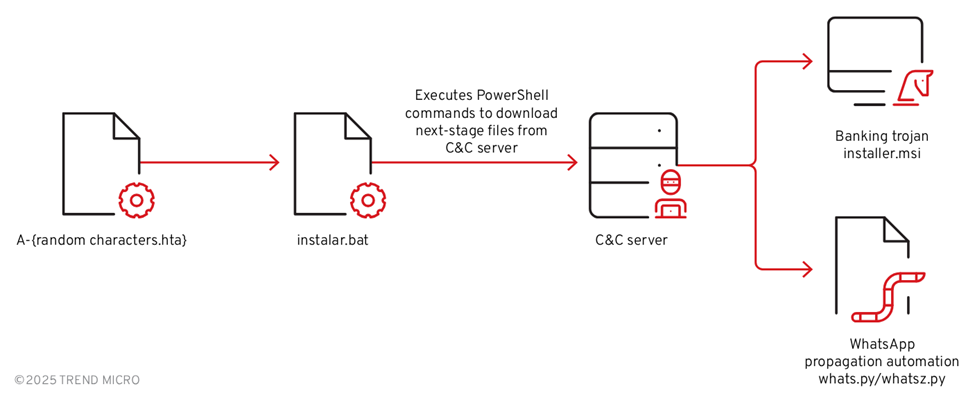


Monitoring, Hunting, Response, and Reversing
Monitoring
Monitoring for this threat should prioritize rich endpoint telemetry (process creation, command-line, script/AMSI, registry, WMI, module loads) and network/proxy/DNS logs capturing downloads from web.whatsapp.com, MSI/EXE pulls, and HTTPS/IMAP connections to suspicious domains, with supplemental identity and banking-platform logs to see session anomalies. Increase log levels on browsers, HTA/WSH, AutoIt, Python, and svchost, and ensure URL-level logging for WhatsApp Web and outbound C2 while retaining sufficient DNS history to pivot on new domains. Key signals include HTA files launched from browser processes, creation of installer paths (for example, temp batch files and MSI execution), AutoIt interpreters spawning svchost with unusual parameters, repeated browser terminations followed by banking-site access, and IMAP connections to unexpected mail providers from endpoints. Gaps to address include limited visibility into WhatsApp Web file transfers, unmanaged/home endpoints used for banking, and insufficient inspection of AutoIt and IMAP traffic. Correlation should link a sequence of events on a host (WhatsApp Web download > HTA run > batch/MSI execution > AutoIt > svchost hollowing > C2/IMAP traffic) and generate high-severity alerts even on single transparent chains; thresholds can be low because HTA and AutoIt are rarely used in typical office workflows. Dashboards should surface HTA executions, AutoIt usage, unusual svchost parents, and IMAP/HTTPS destinations associated with C2, with metrics on “banking-capable endpoints with WhatsApp Web enabled.” Validation can use controlled or simulated activity (benign HTA/AutoIt test scripts, lab replicas of the process tree, mock IMAP C2 traffic) to confirm that detections, correlations, and visualizations fire as expected without overwhelming analysts.
Hunting
Hunting should test hypotheses such as “endpoints received malicious attachments via WhatsApp Web and executed HTA files,” “AutoIt-based loaders are hollowing svchost.exe,” and “IMAP-based C2 is active from user workstations used for banking or crypto access.” Hunters should pull from EDR, proxy/NGFW, DNS, and browser history, focusing on HTA executions with browser parents, AutoIt interpreters launching or injecting into svchost, registry Run keys with unusual paths, and outbound HTTPS/IMAP sessions to unfamiliar domains or mail providers from desktop endpoints. Detection logic can include queries for process relationships (browser > HTA > cmd/batch > MSI > AutoIt > svchost), rare-child svchost processes, abrupt browser terminations followed by reconnection to banking or crypto domains, and endpoints initiating IMAP sessions not generally associated with corporate mail flows. Noise is likely low for HTA execution and AutoIt-sourced process hollowing in most enterprises. Still, it may be higher in environments that use scripting heavily, so hunts should include allowlists for legitimate automation tools and sanctioned IMAP clients while preserving strict scrutiny for consumer endpoints and financial-use hosts.
Response
Response should ensure rapid access to EDR timelines, Windows event logs, registry change logs, browser histories, proxy/DNS records, and banking/transaction logs to reconstruct the path from WhatsApp message reception through HTA execution, loader stages, C2 communications, and eventual banking or crypto activity. Expected artifacts include HTA files, batch scripts, MSI installers, AutoIt executables and scripts, encrypted payloads (.tda/.dmp), relevant Run-key entries, svchost memory images, configuration blobs (including IMAP mailbox details and C2 URLs), and any artifacts of fake banking interfaces or overlays on the endpoint. Anti-forensic behavior centers on anti-virtualization checks, process hollowing, and in-memory decryption rather than on overt log wiping, so responders should focus on capturing volatile memory and network traces early. Event reconstruction should produce a detailed timeline that can feed FAIR estimates of actual TEF, control failures, dwell time, number of impacted accounts, and confirmed or suspected fraud amounts. Likely containment actions include isolating affected endpoints, blocking known C2 and IMAP infrastructure, temporarily restricting WhatsApp Web on high-risk banking endpoints, resetting banking and exchange credentials, and coordinating with financial institutions on monitoring and fraud controls. Priority artifacts for deep analysis include the AutoIt scripts, decrypted payloads, svchost memory dumps, IMAP-based C2 configuration, and any data the trojan collected about banking applications and sessions. Telemetry requirements should emphasize endpoint forensic depth and network session detail rather than relying solely on high-level alerts. IR gaps to address include limited coverage of personal or unmanaged devices and insufficient procedures for messaging app–based infection vectors. DFIR validation should consist of replaying known malware chains in a controlled lab, confirming that detections and playbooks work end to end, and spot-checking closed cases for consistency with the reconstructed patterns.
Reverse Engineering
Reverse engineering should focus first on the loader chain: deobfuscating the HTA/VBScript stage, analyzing the batch and MSI logic that drops AutoIt components and encrypted payloads, and mapping how AutoIt scripts unpack, decrypt, and inject the trojan into svchost.exe while monitoring for persistence setup and process re-injection logic tied to banking window detection. Analysts should document evasion features, including anti-virtualization checks against VM-related services, security product enumeration, and in-memory-only payload execution through custom RC4-like and LZNT1 routines, then characterize hidden persistence markers and Run keys used to restart the malware. Indicators to extract include filenames and paths (for example, specific temp locations, .tda/.dmp payloads), registry keys, network endpoints (C2 domains and IMAP mailbox infrastructure), WMI queries, and window-title patterns related to Brazilian banks and exchanges. Dynamic hooks should be placed on script hosts, AutoIt runtime, process-creation APIs, network APIs, and crypto/decompression routines to capture decrypted payloads and configs at runtime. At the same time, static analysis can recover command strings, configuration formats, banking keyword lists, and backdoor command sets used for remote control. Expected artifacts from this work include unpacked trojan binaries, configuration schemas (including banking targets and C2 failover), signatures for process hollowing, and Yara rules for AutoIt script structures and payload sections. Reverse engineers should also compare recovered samples with known Casbaneiro/Metamorfo variants, build tooling to auto-extract configs and indicators from future samples, and provide structured output (hashes, strings, config fields, ATT&CK mappings) that can be fed directly into detection engineering, hunting, and CTI clustering.
CTI
CTI should refine PIRs around whether this Water Saci cluster is actively targeting your sector, Brazilian geography, or partners that rely on WhatsApp and online banking, how often similar campaigns resurface, which TTPs recur (WhatsApp phishing, multi-format HTA/MSI/AutoIt loaders, IMAP C2, Python/Selenium propagation), and which assets (endpoints used for banking, partner portals, high-value customer desktops) are consistently in scope. SIR work should prioritize closing IOC gaps (additional domains, IPs, hashes, AutoIt, and trojan variants), obtaining and sharing malware samples, mapping infrastructure relationships between C2 domains, IMAP mailboxes, and historic Casbaneiro infrastructure, and specifying which internal logs (proxy/EDR/DNS/banking systems) are required to validate suspected activity. Collection should expand OSINT monitoring beyond a single vendor to multiple threat reports, Brazilian CERT advisories, sandboxes, malware repositories, internal telemetry, and sector ISAC/ISAO channels, with optional dark web collection focused on sale or advertisement of Brazilian banking malware families. Mapping and analysis should cluster Water Saci-related infrastructure and tooling, maintain ATT&CK-based TTP profiles over time, compare with historical Brazilian banking malware campaigns, track new capabilities such as AI-assisted script conversion, assign clear confidence levels on attribution and relationships, and continuously test or revise working hypotheses as new telemetry and reporting emerge, feeding updated risk scenarios back into FAIR-informed decision making.
GRC and Testing
Governance
Governance updates should ensure policies explicitly address malware propagation through consumer messaging platforms like WhatsApp, reinforce restrictions on HTA/script execution, and mandate secure-use expectations for employees performing banking or financial transactions on Windows endpoints. Oversight functions should review whether RA, PM, and PL family governance documents incorporate controls for user-executed multi-stage malware, script-based loaders, and C2 channels disguised as regular HTTPS/IMAP traffic. The risk register should be updated with a Water Saci–aligned scenario that describes elevated susceptibility to messaging-based social engineering, a high-threat capability, and gaps in the detection of AutoIt and process-hollowing activity. Board and executive communications should summarize fraud, potential financial loss, customer account exposure, and implications for regulatory or reputational risk, while highlighting required investments in monitoring, endpoint hardening, and social-engineering controls.
Audit and Offensive Security Testing
Audit should assess whether current controls detect HTA/AutoIt loader execution, process hollowing, and IMAP-based C2, and identify evidence gaps, such as weak logging for WhatsApp Web artifacts, insufficient registry and process telemetry, and limited monitoring of Python- or Selenium-based automation on endpoints. Policies governing acceptable use, anti-malware, boundary protection, and configuration baselines should be validated against the campaign’s multi-stage infection path. At the same time, compliance teams evaluate alignment to regulatory expectations for fraud prevention and customer data protection. Red team exercises should simulate WhatsApp-delivered malicious attachments, HTA execution, and AutoIt-based loaders to confirm detection and response, followed by purple-team refinement to improve behavioral detections and correlation logic. Penetration-testing scopes should expand to include messaging-app vectors, script-execution pathways, and endpoint-resilience testing against process injection and in-memory payloads, with exploit reproduction focused on validating whether controls block or at least log each stage of the infection chain.
Awareness Training
Awareness training should emphasize social engineering through trusted-contact messaging platforms, reinforcing that malicious ZIP, PDF, and HTA files can arrive via WhatsApp and are not inherently safer than email attachments. Training must address human failure modes such as trust bias, rapid-click behavior, and lack of scrutiny for “update” or “urgent” prompts, with tailored modules for admins (script execution and C2 detection), finance and customer-facing staff (banking-session integrity and fraud signals), and executives (high-value account risk). Employees should learn to recognize behavioral indicators such as unexpected file transfers, prompts to run scripts to view documents, sudden browser closures, or login interruptions. Phishing simulations should incorporate messaging-app–style lures and multi-format payloads to match the attacker’s TTPs, supported by communication guidelines that clarify safe handling of customer data, financial actions, and cross-channel verification requirements. Reinforcement cycles should include quarterly simulations and periodic microlearning tied to emerging variants, with effectiveness measured through click rates, report rates, and downstream control improvements.
Indicators of Compromise
From the original artifact, as follows:
2d95769a016b397333ba90fdc2f668f883c64774a2c0aaaf6b2d942bebaee9e0 |
c03fecbf52c38cf363bbc4f94bbe183e394f921af756442b674f4fe5f2b2090c |
12f2e7e997480a3ea3150614664d6de4e6e229dacd6e8ff0ed74cd22207e753d |
495697717be4a80c9db9fe2dbb40c57d4811ffe5ebceb9375666066b3dda73c3 |
9b0996380c61060ed3bfec25962c56131ea0eac42c7f373216aab72fdb7b8ac7 |
15e8f315901ea12639665f1adb9d18a9ace1074a33d70e47ad43203eb8ebfba4 |
6745bb11b8c692be78ec7ade285094beef907ecb3a99f475afa284ccbe7565f2 |
6ee5355b786282a6904806a4f55e59e9aad8067ae01b37afaf0009527e5c0205 |
ec69a53fd3ff11327aa98248bf55572f4ea8c1b40a12f49f5669f3df1f598353 |
5db59a8a8c2ca54615a6079fa9035d2886c1ec2270ee508efbb0ff98c98b90be |
de07516f39845fb91d9b4f78abeb32933f39282540f8920fe6508057eedcbbea |
a416cad095a6e77857f8fba4552ddc8ece41ce997b5086a4fbea5ac0fdfc4860 |
67ad7a950257cc5920b2119539049bcea3863bb2002f7118fcef57788f7eca59 |
ebe37505fa162461515d50bd86cb0fd983a000d418f0be0f9098e087170909bd |
f262434276f3fa09915479277f696585d0b0e4e72e72cbc924c658d7bb07a3ff |
storeshomeestusfluworkss[.]online |
hxxps://centrogauchodabahia123[.]com/altor/installer[.]msi |
centrogauchodabahia123[.]com |
hxxps://centrogauchodabahia123[.]com/altor/whatsz[.]py |


Comments